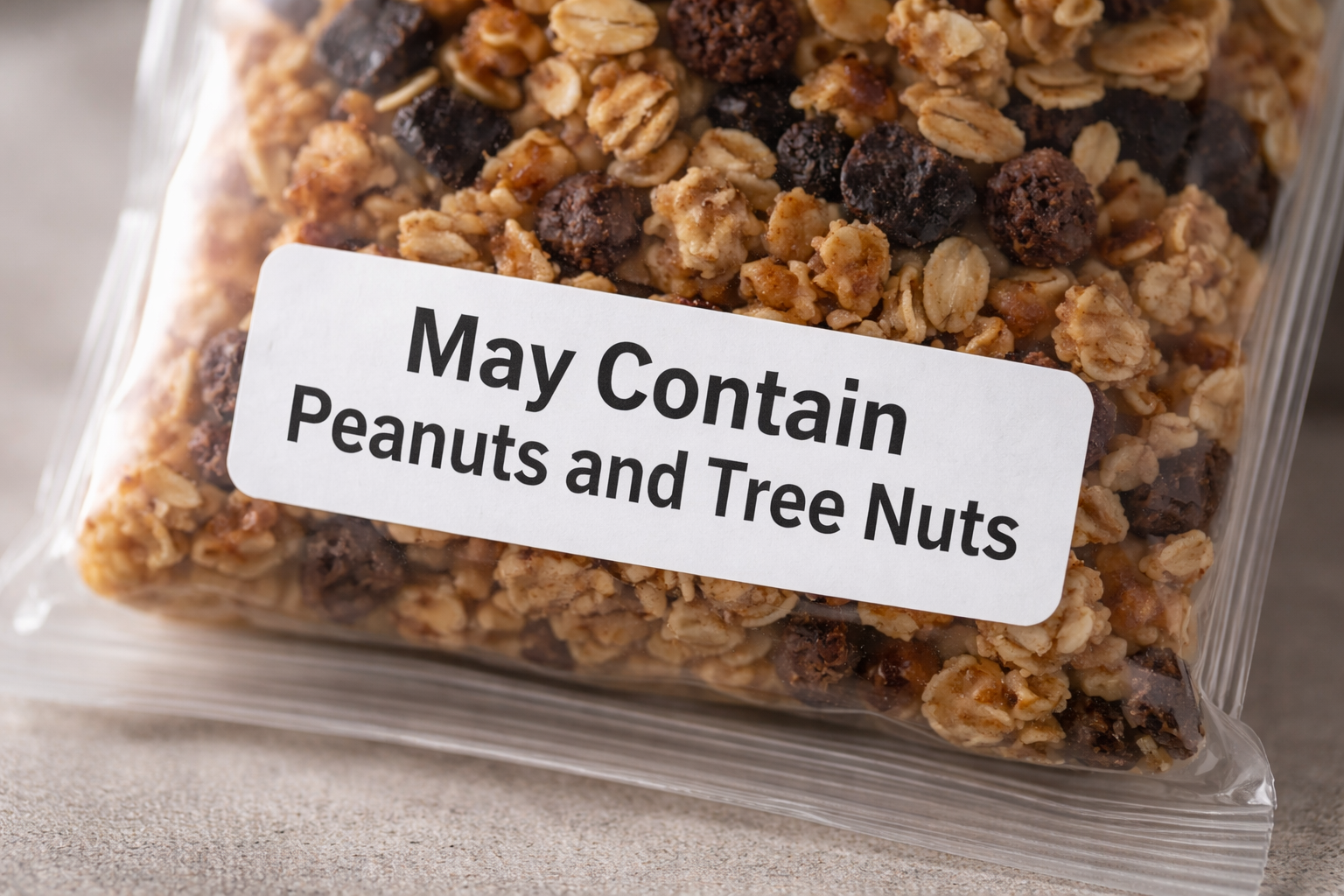
What the FDA's 'May Contain' Label Overhaul Means for Nut-Free Families
The label says "may contain peanuts." Another product has the same ingredient list, no nuts anywhere in the recipe, but says "processed in a shared facility." A third product says nothing at all about cross-contact, even though it's made on equipment that also runs peanut products. All three were manufactured this week. None of those warnings were required by law.
This is the current reality of precautionary allergen labeling in the United States. And the FDA is now asking whether it should change.
In February 2026, the FDA held a virtual public meeting and listening sessions to explore whether the existing, voluntary "may contain" system should be replaced with a science-based threshold framework. Under the proposal, precautionary warnings would be linked to [scientific reference doses for major allergens](https://www.fda.gov/food/workshops-meetings-webinars-food-and-dietary-supplements/virtual-public-meeting-and-listening-session-food-allergen-thresholds-and-their-potential) rather than left entirely to manufacturer discretion. The public comment period is open through May 19, 2026, and the allergy community has a real opportunity to shape what comes next. For families navigating nut allergies every day, this conversation matters. Here is what it actually means.
What "May Contain" Labels Are Right Now
Under current federal law, required ingredient labeling covers only what a manufacturer intentionally adds to a recipe. Cross-contact from shared equipment or shared facilities does not trigger any labeling requirement. Manufacturers who choose to warn about potential cross-contact can do so, using phrases like "may contain," "manufactured in a facility with," or "processed on equipment shared with." They are not required to say anything.
The result is a system that is effectively unregulated at the precautionary level. A survey of food allergy families found that only about half of respondents knew these labels are voluntary. Many assumed the different phrases reflected different risk levels. They do not. "May contain peanuts" and "manufactured in a facility that also processes tree nuts" are not legally defined, not standardized, and not subject to any minimum risk threshold. One brand may add warnings to products with negligible allergen cross-contact; another may make no mention of nuts on equipment that runs peanut products the same day.
For nut allergy families, this creates an impossible situation: the presence of a warning is not a reliable measure of risk, and the absence of a warning does not mean the product is safe. The NutFree Confidence Checklist exists precisely because of this gap, giving families a practical framework for evaluating current labels while the regulatory landscape remains unsettled.
What the FDA Is Proposing to Change
The February 18, 2026 meeting brought together FDA scientists, allergists, food manufacturers, and patient advocates to evaluate whether the U.S. should move toward an allergen threshold system. The core concept is this: researchers have identified reference doses for major food allergens. These are amounts of allergenic protein that, based on available clinical data, are unlikely to trigger a reaction in the majority of people with that allergy.
For peanut, international bodies including WHO and FAO have cited approximately 2 milligrams of peanut protein as a meaningful reference point. Under a threshold-based system, manufacturers would assess whether their cross-contact risk exceeds that threshold. Precautionary warnings would then reflect actual measured risk rather than legal caution or individual company policy.
Australia has operated a voluntary version of this approach for years through its VITAL (Voluntary Incidental Trace Allergen Labelling) program, which ties standardized "may be present" language to reference dose data. The FDA is studying that model. Experts at the February meeting largely supported the threshold concept as an improvement over the current situation.
The critical question is whether any new system would be mandatory or remain voluntary. The Food Allergy Research and Education organization (FARE) and other advocates pushed hard at the meeting for mandatory standardization. Patient advocate Jill Mindlin said it directly: without mandatory rules, "things will be exactly the same as where we are today, which is a mass of confusion." That outcome is still unresolved. Any final rule would go through the full federal rulemaking process before taking effect.
What This Means for Highly Sensitive Individuals
A threshold-based system is designed around population-level data. It aims to protect the majority of people with a given allergy from reactions caused by trace cross-contact. That is a meaningful improvement over the current inconsistency. But it raises a legitimate concern for families with highly sensitive individuals.
Reference doses reflect what is likely to affect most people. They do not account for individuals who react to amounts well below the population-level threshold. A 2-milligram peanut protein figure does not mean 1.8 milligrams is risk-free for every person with a peanut allergy. Sensitivity varies substantially from person to person, and even within the same person over time. A history of mild reactions also does not predict mild future reactions, as a McGill University study presented at the 2026 AAAAI Annual Meeting confirmed, finding that 23 percent of second reactions in children were more severe than the first.
A well-implemented threshold system would clean up a great deal of noise in the current labeling environment. It would not eliminate the need for families with highly sensitive members to seek out products with genuinely zero cross-contact risk.
Why Dedicated Nut-Free Facilities Matter More Under a Threshold System
Here is the counterintuitive reality of a threshold-based overhaul: if it becomes law, some manufacturers may actually remove their "may contain" warnings. If they have tested their product's cross-contact level and it falls below the reference dose, they would have scientific cover to say nothing about nuts at all. For many people with nut allergies, that may be fine. For highly sensitive individuals, the absence of a warning would carry a very different meaning than it does today. Families would need to trust each manufacturer's testing methodology, the accuracy of the thresholds themselves, and the honesty of the labeling decision.
That is a significant amount of trust to place in a voluntary system.
What "Dedicated Nut-Free Facility" Actually Means
A dedicated nut-free facility is one where no nuts of any kind are brought in, stored, or processed. There is no shared equipment. There are no shared production lines. There are no cleaning protocols that could leave trace residue because there are nothing to clean off. When a product comes from a dedicated nut-free facility, the question of how much peanut protein might be present simply does not arise. The answer is none.
This is why NutFreeMarket was built around this specific standard. Every vendor on the platform operates a dedicated nut-free facility. The curation is not about finding products without nuts in the ingredient list. It is about sourcing from environments where cross-contact is structurally impossible, not just managed.
Under any labeling regime, mandatory threshold or voluntary precautionary, that standard does not change. As labels become more nuanced and harder to evaluate without access to a manufacturer's testing data, the value of buying from a facility that simply does not use nuts becomes clearer. It eliminates the analysis entirely.
What Families Can Do Right Now
The FDA's label overhaul is not yet a rule. Current labeling laws, inconsistent as they are, remain in effect. A few steps families can take while the regulatory picture develops:
Submit a comment to the FDA. The public comment period for docket FDA-2026-N-1304 is open through May 19, 2026. If your family has concerns about threshold-based labeling, about mandatory versus voluntary requirements, or about how labels should communicate risk to highly sensitive individuals, this is the formal channel for that input. Individual comments from patients and families carry weight in the rulemaking process.
Understand what labels actually mean today. The NutFree Confidence Checklist walks through the current precautionary label landscape so families can evaluate products accurately while these regulations remain in flux.
Verify facility status, not just ingredients. A product without a "may contain" warning is not automatically safe for a highly sensitive individual. Contacting a manufacturer's allergen line directly, or choosing dedicated-facility products, remains the most reliable step available under current rules.
For a broader foundation on nut allergy management, The Complete Parent Guide to Handling a Child's Nut Allergy covers label reading, emergency preparedness, and working with schools and caregivers.
Frequently Asked Questions
What does "may contain" mean on a food label?
"May contain" is a voluntary precautionary statement that manufacturers add to warn about potential cross-contact during production. It is not required by federal law, not standardized across brands, and not linked to any specific amount of allergen. Two products with similar cross-contact risk may be labeled differently, and some products with genuine risk carry no warning at all.
Is the FDA changing allergen labeling in 2026?
The FDA held a public meeting in February 2026 to evaluate replacing voluntary "may contain" labels with a threshold-based framework, but no final rule has been issued. The proposal is under review. A public comment period is open through May 19, 2026 at regulations.gov docket FDA-2026-N-1304. Any formal change would go through the full federal rulemaking process.
What is an allergen reference dose?
A reference dose is a scientifically established level of allergenic protein that is unlikely to trigger a reaction in most people with a given allergy, based on clinical data. For peanut, international authorities have cited approximately 2 milligrams of peanut protein as a reference point. The FDA is considering using reference doses to standardize when precautionary labels are required, rather than leaving the decision entirely to manufacturers.
If the FDA adopts thresholds, will "may contain" products become safe for nut-allergic families?
Not necessarily, and not for everyone. Reference doses are derived from population-level data and may not reflect the sensitivity of every individual. Some people react to amounts well below established thresholds. A threshold-based system would improve labeling consistency across the industry, but it would not eliminate cross-contact risk for all individuals. Dedicated nut-free facilities remain the most reliable option for families with highly sensitive members.
How is a dedicated nut-free facility different from a product simply labeled "nut-free"?
A dedicated nut-free facility produces no nut-containing products on-site at any point. Nuts are never stored, processed, or introduced in the facility. A product labeled "nut-free" may still come from a shared environment where nuts are present but managed through cleaning protocols. The distinction is structural: dedicated facilities eliminate cross-contact risk at the source rather than controlling it.
Can I submit a comment to the FDA about allergen labeling?
Yes. Comments can be submitted through May 19, 2026, at regulations.gov under docket FDA-2026-N-1304. Patients, families, allergists, and patient advocates can all submit input that the FDA will consider as it evaluates next steps.
What happens if manufacturers remove "may contain" warnings under a new threshold system?
If a threshold system is adopted and a manufacturer determines their cross-contact level falls below the reference dose, they may no longer include a precautionary warning. For most people with nut allergies, that could reflect accurate risk. For highly sensitive individuals, the absence of a warning would no longer carry the same meaning it does today. Shopping from dedicated nut-free facilities removes this ambiguity entirely.
Where can I find products from dedicated nut-free facilities?
NutFreeMarket is a curated marketplace featuring only products from vendors operating dedicated nut-free facilities. NutFreeMarket reviews each maker's self-attestation and any documentation they provide before listing.
Medical Disclaimer: The information in this article is intended for general informational purposes only and does not constitute medical advice. Food allergy management is highly individual. Always consult a qualified allergist or medical professional before making decisions about your health or your child's health.