I Was Worried to Eat in Japan with Food Allergies. Then I Found Equal Eats.
Before I booked my trip to Japan, I spent a lot of time thinking about food.
The exciting part came easy: ramen at 2 a.m., convenience store onigiri, yakitori down some tiny street. Japan has food I'd been curious about my whole life.
And then there was the other kind of thinking. The kind that didn't turn off.
What if they don't understand me? What if I can't read the label? What if I'm standing at a street food cart with no way to explain what my allergy actually means, to someone who doesn't speak English, in a country that handles allergen labeling completely differently than what I'm used to?
My biggest fear about Japan had nothing to do with trains or temples.
It was communicating my nut allergies.
Japan Labels Food Allergens Differently Than the US
Here's something a lot of travelers with food allergies don't realize until they're already planning the trip: Japan's allergen labeling system isn't the same as ours.
In the US, the FDA requires labeling for the Top 9 allergens: milk, eggs, fish, shellfish, tree nuts, peanuts, wheat, soybeans, and sesame.
Japan operates under a different framework, overseen by the Consumer Affairs Agency. As of 2026, Japan mandates labeling for 9 specific allergens: shrimp, crab, wheat, buckwheat, egg, milk, peanut, walnut, and cashew nut. There's also a longer recommended disclosure list, but that guidance is voluntary.
A few things that stand out:
"Tree nuts" as a broad category isn't in Japan's mandatory list. Specific nuts are listed individually. Sesame isn't mandatory. Soy isn't mandatory.
So if you're traveling with a nut allergy and expecting Japanese food packaging to flag everything you need to watch for, it might. Or it might not. And that's packaged goods. Restaurants are a whole other conversation.
That conversation is exactly what I didn't know how to have.
What Equal Eats Is
A few months before the trip, I found Equal Eats.
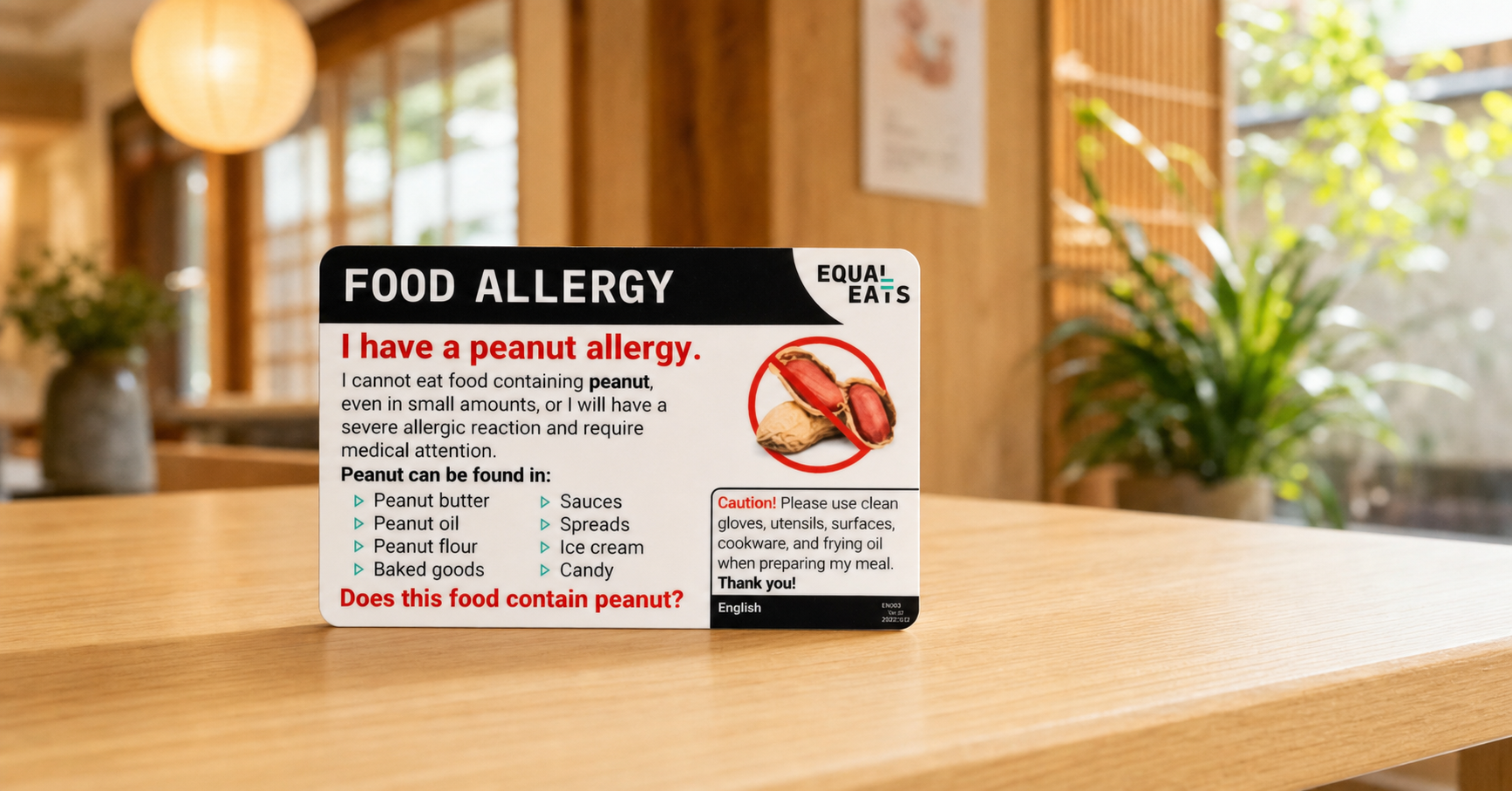
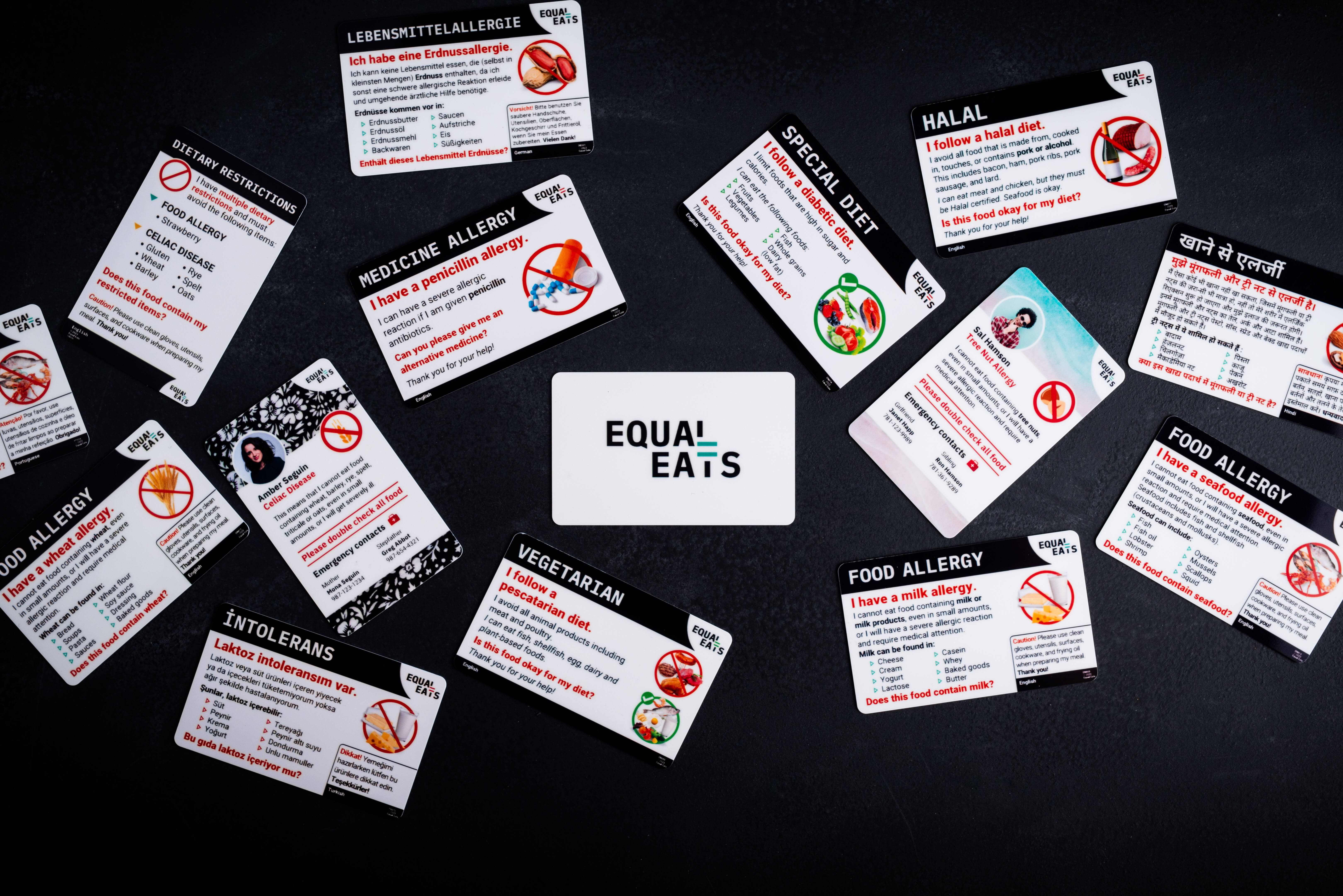
Equal Eats makes small, wallet-sized cards you show to whoever is preparing or serving your food. They're allergy translation cards, specifically built for travel.
And they're more than a translation. They're written the way a professional communicates an allergy to a kitchen. They explain:
- What you can't eat (your specific allergens)
- How serious a reaction can be
- What "safe" actually means in a kitchen context: no traces, no shared tools, no shared cooking surfaces, no contaminated oil
In the local language. So the server can walk the card back to the chef. No broken game of telephone. No hoping the message survived the trip from the front of house to the kitchen.
I ordered a card with my nut allergy translated into Japanese and tucked it in my wallet. Then I got on the plane.
What Happened in Japan
Japan was incredible.
In the more touristy areas, some English was around. But in a lot of places, it wasn't. And even when a front-of-house person could manage a few words of English, there was no guarantee that would translate accurately back to whoever was cooking.
The Equal Eats card solved that problem.
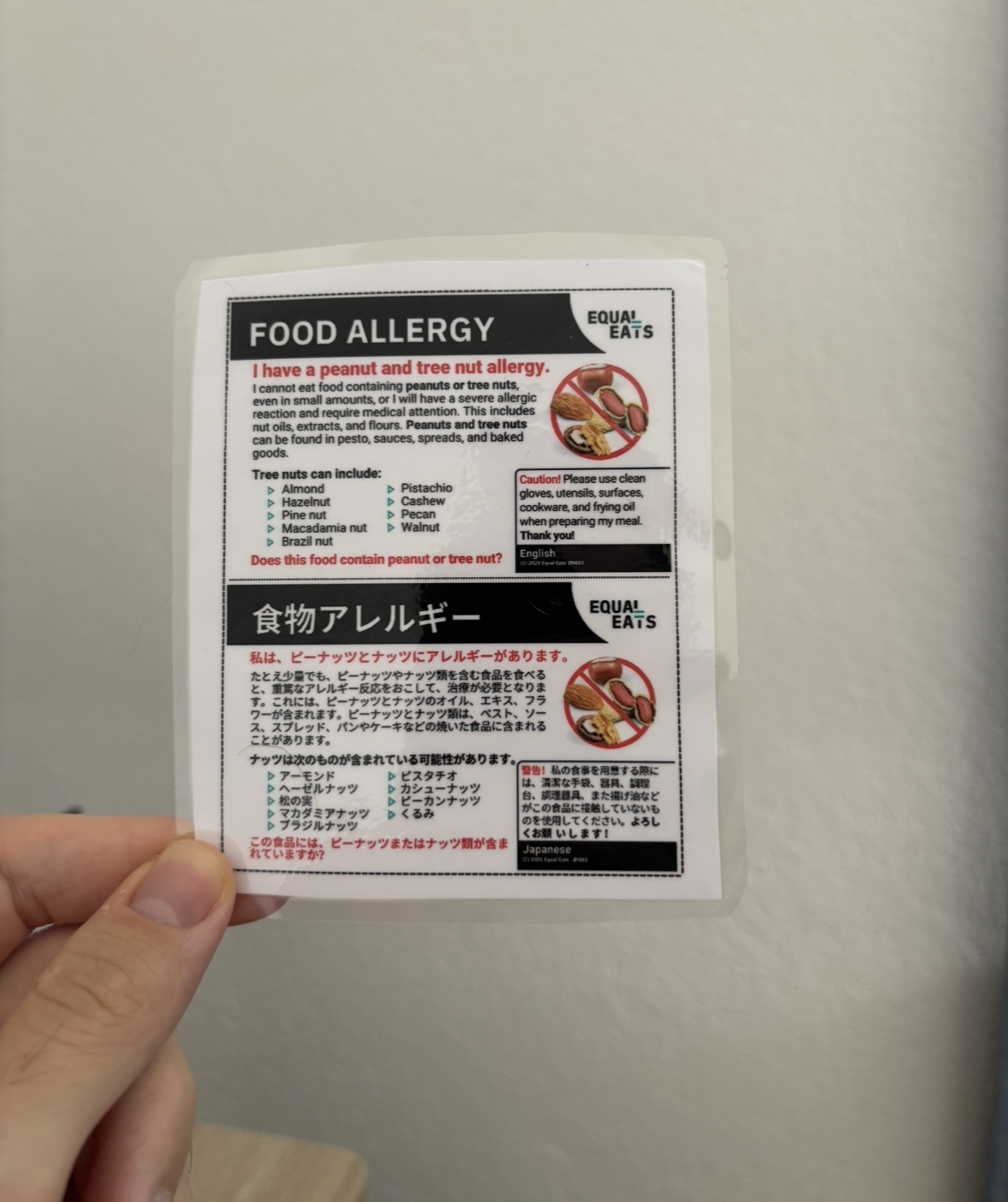
I used it at every restaurant I went to. Even the places where I felt fairly confident about the food. Because you never really know, and handing over a card costs nothing except a few seconds.
What surprised me was the reaction.
Some places triple-checked. A server would take the card to the kitchen, come back to confirm, and sometimes a manager or chef would come out personally. It didn't feel like a burden to them. It felt like they understood the stakes.
And then there was a moment at a matcha ice cream stand.
Without the card, I would have walked away. I had no way to have that conversation on my own, in Japanese, in the moment. With the card, I could ask.
boom:
Matcha ice cream. In Japan. Because I could actually ask.
If I didn't have the Equal Eats card, I would have missed it entirely. That feels like a small thing. It wasn't.
Being in Japan, Instead of Being in My Head
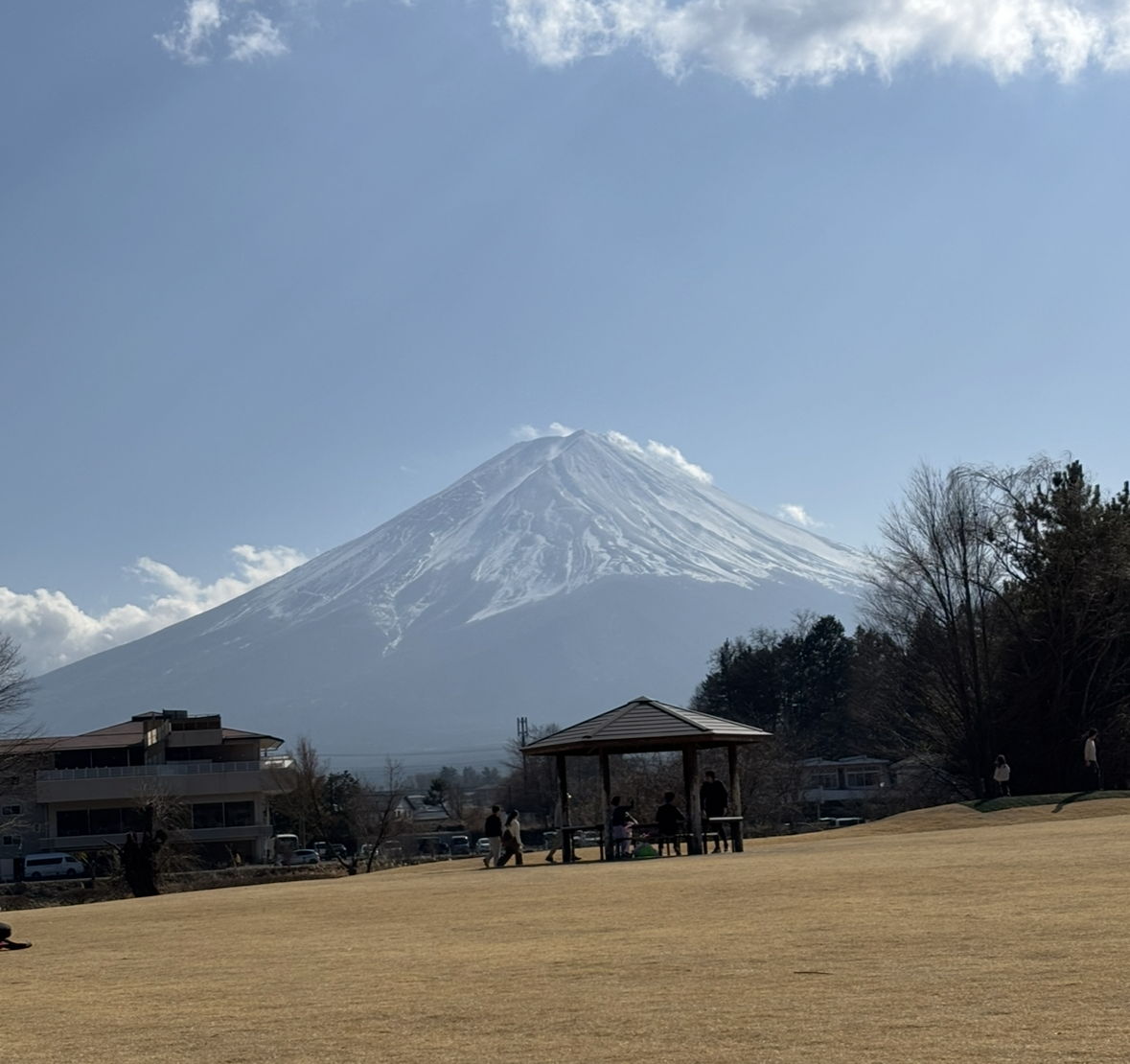
Here's what most people don't think about when it comes to traveling with a food allergy…
It's not just the food decisions. It's the weight of every food decision.
Before every meal, you're running scenarios. Reading the room, reading the menu, reading the people. Deciding whether to ask questions and risk a blank stare, or just skip it and find something you already know is safe.
That loop is exhausting. Especially when you're in a country with a different language and a different labeling system.
Having the card made the loop shorter.
I handed it over. I waited for a real response. I made a call based on what I saw and heard. And then I was done thinking about that meal.
So I was actually in Japan. Present. Doing the thing I went to do.
That's what this is really about.
One important thing to know: a card is a powerful tool, and it works best alongside your own judgment. My approach throughout the trip was card plus a direct check: "Can you accommodate this safely?" The card handles the communication heavy lifting. You still make the final call based on how confident you feel in the response. Advanced planning, asking questions, and carrying appropriate medication are still the foundation. The card is part of the system, not a replacement for it.
If you're building out your full travel prep, this guide on traveling nut-free covers the bigger picture, from airlines to hotels to restaurant strategy.
This Is What NutFreeMarket Is Built Around
I started NutFreeMarket because living with a nut allergy means doing extra work that other people don't have to do.
Reading every label twice. Researching every restaurant before you go. Carrying medication everywhere. Asking questions that might make you feel like you're being difficult.
Equal Eats is one tool in that toolkit. And it removes one specific obstacle that was standing between me and a whole country full of food I wanted to try.
That's the kind of discovery I want this site to surface: tools and information that close the gap between what you can theoretically do and what you actually feel confident doing.
And if you're working on restaurant conversations closer to home, this post on eating out safely with a nut allergy covers a lot of the same instincts.
Get Your Equal Eats Card
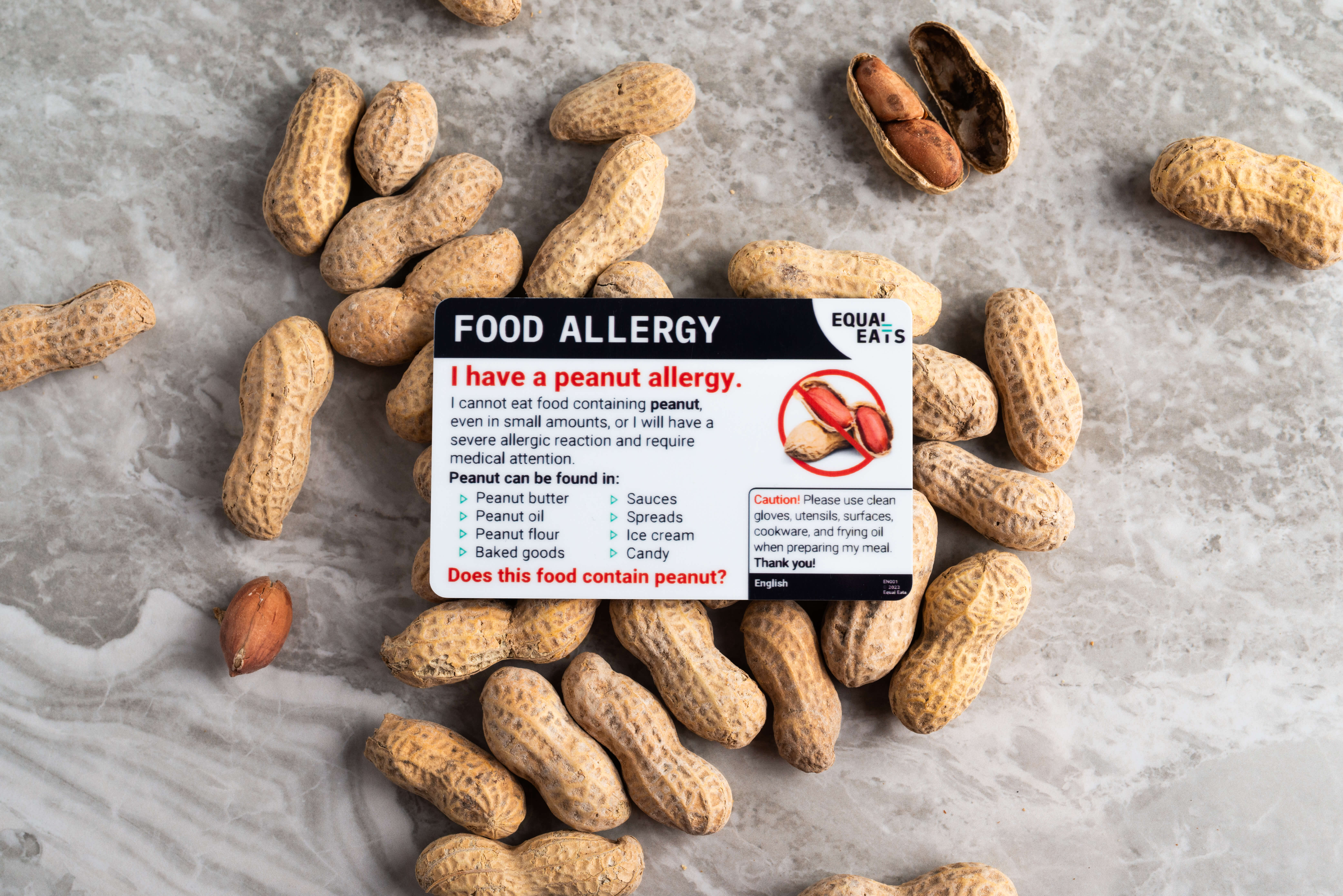
If you're traveling somewhere where a language barrier could be an issue, an Equal Eats card is worth having.
You can get yours at equaleats.com. Use that link and you'll get 10% off your order. It also supports NutFreeMarket, which helps us keep supporting the peanut and tree nut-free community.
Pair it with your research, your medication, and your own instincts. Then go.
Affiliate disclaimer: This post contains affiliate links. If you purchase through our link, NutFreeMarket earns a small commission at no extra cost to you. We only recommend things we've personally used or that we'd genuinely stand behind.
Frequently Asked Questions
Do allergy translation cards actually work in Japan?
In my experience, yes. Japanese restaurant culture takes food safety seriously, and a professionally translated card gives staff something concrete to act on. I used mine at every restaurant I visited in Japan in February 2026 and consistently got careful, thorough responses. Some places triple-checked with the kitchen before serving me. That said, always pair the card with a direct question and trust your instincts if something feels off.
How is Japan's allergen labeling different from the US?
The US requires labeling for the Top 9 allergens (milk, eggs, fish, shellfish, tree nuts, peanuts, wheat, soybeans, sesame). Japan's mandatory list, as administered by the Consumer Affairs Agency, currently covers 9 specific items: shrimp, crab, wheat, buckwheat, egg, milk, peanut, walnut, and cashew nut. Japan does not mandate broad "tree nut" category labeling as a group, does not require sesame, and does not require soy. There's also a longer recommended (but optional) disclosure list. This means a product that would carry a warning in the US might not flag anything in Japan.
What is an Equal Eats card?
Equal Eats cards are professionally translated, wallet-sized cards that communicate your specific allergy or dietary restriction to food service staff. They explain what you can't eat, how serious a reaction can be, and what kitchen safety actually looks like (no cross-contact, clean tools, separate oil, etc.). They're available in many language combinations and designed to be shown directly to kitchen staff, not just the person taking your order.
Is a translation card enough on its own when eating out abroad?
A card is a powerful communication tool and one of the most practical things you can bring for international travel with a food allergy. But it works best as part of a broader approach: research restaurants ahead of time, confirm with staff ("Can you accommodate this safely?"), and make the final call based on how confident you feel in the response. Always carry appropriate medication.
Where can I get an Equal Eats card?
At equaleats.com. Use that link for 10% off. They offer cards for a wide range of allergens and dietary restrictions in many language combinations.