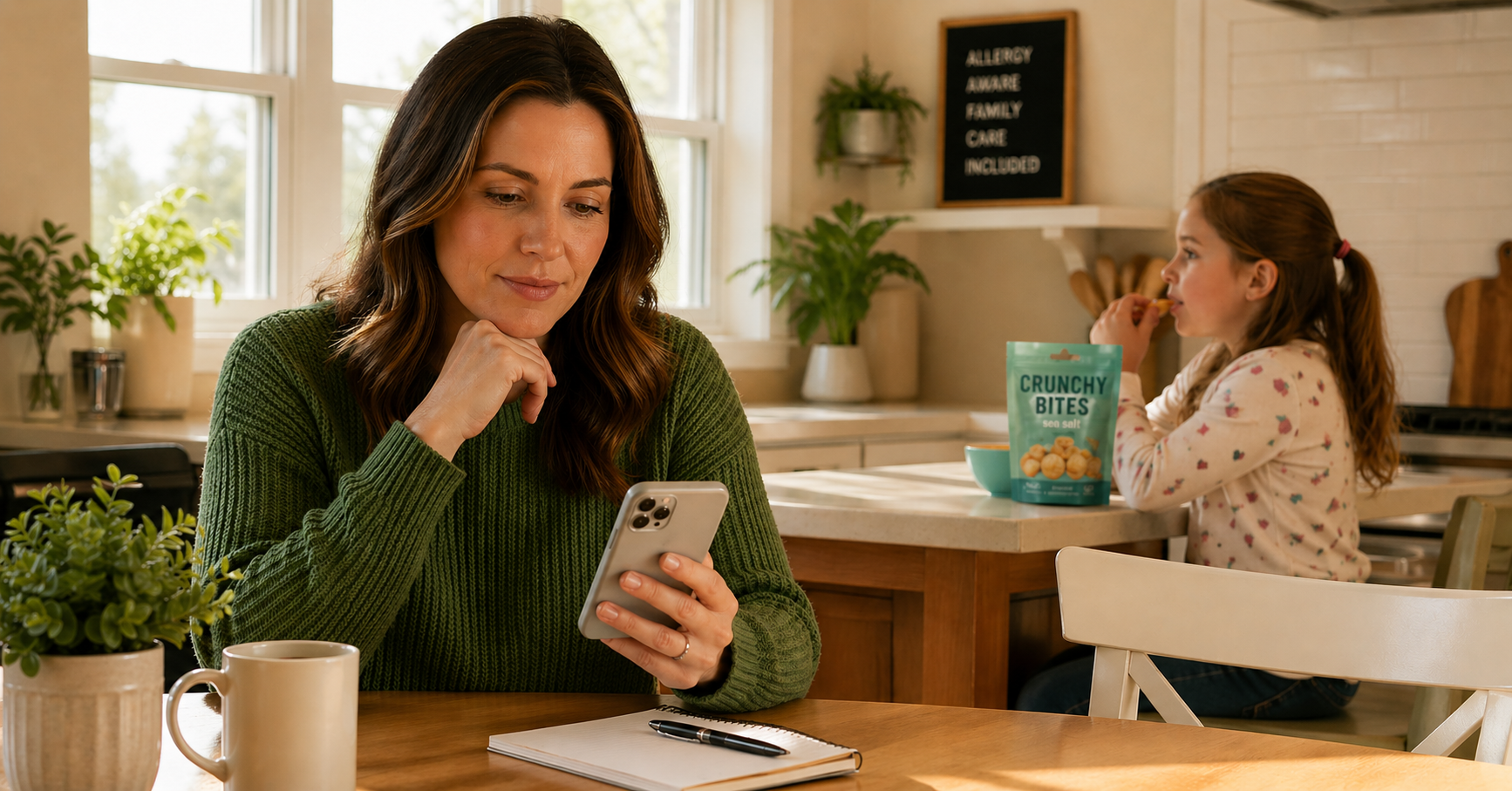
Allergy Misinformation: 4 Red Flags Every Food Allergy Parent Should Recognize
The accounts sharing the most dangerous food allergy misinformation on social media are usually not trying to mislead anyone. A published analysis of food allergy content on social media examined 12.3 million views of posts and found that 31 percent was promoting natural cures with no clinical evidence. Most of that content came from parents who had tried something, believed it worked, and were sharing in good faith.
That detail matters. Misinformation that comes from a trusted community member, in a caring tone, about something they experienced personally, looks completely different from misinformation peddled by a stranger selling a supplement. The content can be just as harmful. It reads very differently.
Once you know what to look for, four red flags become hard to unsee.
Red Flag #1: The Natural Cure Promise
If a post promises that a specific food, supplement, protocol, or lifestyle change will "cure" or "eliminate" a food allergy, that is the clearest signal that the content is not grounded in current clinical evidence.
This does not mean diet, gut health, and immune function are irrelevant to allergy science. Researchers are actively studying these connections. The microbiome and allergy development is a legitimate area of inquiry. But what a peer-reviewed paper describes as "a promising area for further study" frequently becomes "this cured my kid's peanut allergy" in the social media content layer.
The distinction matters because a parent who believes a natural cure has worked may reduce or discontinue the precautions, avoidance, emergency medication, label reading, that are currently the only clinically supported tools for managing a food allergy. The risk is not just the misinformation itself. It is the behavior change that follows from believing it.
When you see a cure claim, one question cuts through most of it: where is this in the clinical literature? A treatment that works will eventually show up in a published trial. A quick search of PubMed, FARE, or ACAAI for the treatment name gives you a fast answer. If nothing comes up, that absence is meaningful information.
Red Flag #2: The Missing Medical Voice
Good allergy information names its source. It links to a study, quotes a credentialed clinician, or describes a mechanism clearly enough that you could look it up. Watch for content that is confident and specific but has no medical voice anywhere near it.
"We did this for three months and my daughter can now eat peanut butter every day" is real. As a data point to act on for another child, it is not sufficient. The experience may be genuine. The conclusion drawn from it may be incorrect. And the two things can both be true at the same time.
This red flag is especially important around treatment updates. The food allergy treatment pipeline is genuinely moving fast right now, with patch therapy, sublingual tablets, biologics, and updated epinephrine approvals all advancing. The 2026 treatment pipeline is worth understanding in full so you know what real clinical progress looks like before a social media version of it reaches you. Legitimate treatment news shows up in established allergy journalism and in trial registries. If a major update appears in your feed before it appears anywhere on FARE, ACAAI, or Allergic Living, slow down.
Red Flag #3: The Anecdote Without the Caveat
Personal experience from other allergy parents is one of the most valuable things the community has. Parents who have navigated FPIES diagnoses, tried OIT with a teenager, or managed an allergic child through years of school cafeteria negotiations carry practical knowledge that clinical literature rarely captures. Communities built around shared experience are a real resource.
Anecdotes become a red flag when the caveat disappears and they are presented as prescriptions rather than data points.
"This worked for us" is useful. "This is what you should do" is the flag. The caveat that every allergy profile is different, that reaction history varies, and that what worked in one case can fail in another does not reduce the usefulness of the story. It is the part that makes the story safe to share.
When the caveat is missing, it usually signals one of two things: the person does not have enough experience with allergy variability to include it, or they have left it out to make the content feel more actionable. Both are reasons to read with more care.
Red Flag #4: The Fear Without a Path Forward
Some misinformation does not promise cures. It runs in the opposite direction: content that amplifies risk and threat without offering any meaningful guidance or resolution.
This content is identifiable because it produces anxiety without any corresponding reduction in risk. It names dangers, describes worst-case scenarios, generates engagement through fear, and the family reading it ends at roughly the same place they started, just more frightened.
Good allergy information does the opposite. It identifies a risk, explains the mechanism clearly, and offers something actionable: how to read for this allergen, who to call, what to ask your allergist, where to find verified safe products. The goal of useful content is to leave the reader better equipped.
Recall aggregation that stops at the recall fits this pattern. So does outbreak coverage that stops at the outbreak. Understanding the labeling failures behind most peanut and tree nut recalls, including why "may contain" disclosures are so inconsistent and what the FDA is working to change, puts individual events in context and gives families something concrete to act on. Fear without context is not safety information.
What Trusted Information Actually Looks Like
The organizations that have earned credibility in the food allergy community share a few characteristics. They link to primary sources. They name their contributors. They update their guidance when the evidence changes. And they are willing to say "we do not know yet" in areas where the research has not settled. FARE, ACAAI, and Allergic Living operate in this register and have for years.
Your allergist is still the authoritative source for your specific child's management plan. No website or community group replaces that relationship.
One practical note: the four red flags above are easier to apply to content that appears in your feed than to content you are searching for under stress. When you search with high anxiety and a specific question, you are more likely to stop at the first answer that feels satisfying. Bookmarking credible sources before you need them is more useful than trying to evaluate quality in the middle of a difficult moment.
Frequently Asked Questions
What are the most reliable websites for food allergy information?
FARE, ACAAI, and Allergic Living are the most established resources for clinically grounded food allergy information. They link to primary sources, name their contributors, and update their guidance when evidence changes. Your allergist is the authoritative source for anything specific to your child's situation.
How do I know if a food allergy treatment I'm reading about has clinical evidence behind it?
Search for the treatment on PubMed or in FARE's research section. Treatments under legitimate clinical investigation will have registered trials. If a claimed treatment appears in neither place, the evidence base is not clinical. For many "natural cure" claims, the absence of a trial record is meaningful information, not just an oversight.
My child had a mild first reaction to peanut. Does that mean future reactions will also be mild?
No. Research presented at the 2026 AAAAI annual meeting found that reaction severity is not predictable from one exposure to the next. A mild first reaction does not indicate that future reactions will be mild. Allergists recommend maintaining epinephrine auto-injectors and avoidance protocols regardless of prior reaction severity. This is one of the most important things to discuss with your allergist directly.
What should I do when I see questionable allergy information on social media?
Before sharing or acting on it, check whether the claim appears on FARE, ACAAI, or Allergic Living. Check whether the original source is a clinical study, a credentialed clinician, or an individual's personal experience. If the post is about a treatment, look for it here. If you are uncertain about how it applies to your child, your allergist is the right person to ask.
Is community knowledge from other allergy parents actually useful?
Yes, and this is worth saying clearly. Parents with years of practical experience navigating schools, restaurants, travel, and birthday parties have insights that clinical literature rarely captures. The concern is community knowledge that loses its caveat and becomes a universal prescription. Every allergy profile is different. "This worked for our family" is genuinely worth knowing. "You should do exactly what we did" needs the acknowledgment that every child is different, which experienced community voices almost always include.
For the Daily Food Question
The misinformation problem is one layer of the challenge. The other layer is practical and daily: what does your child eat for lunch tomorrow? What do you bring to the birthday party? What do you order when you are not home?
The answer to the daily food question does not require trusting a social media post or hoping a label is accurate. NutFreeMarket carries products exclusively from vendors who operate from dedicated peanut- and tree nut-free facilities. The vetting is done before the product reaches the listing. Every item on the site has cleared the source-level standard that the recall pattern keeps reminding us matters most.
Browse nut-free snacks from dedicated facilities at NutFreeMarket.