Adulting with Nut Allergies: How to Thrive in Work, Travel, Relationships & Social Life
In this guide, you’ll find real-world tactics — clear, actionable, adult-focused — to handle career demands, business travel, social life, and the psychological load of living with nut allergies.
Having a nut allergies isn’t just a childhood problem; once you’re in the adult world — full-time work, business trips, social dinners, moving in together — the stakes change. If you’ve ever felt like your allergy is standing between you and normal adult life, you’re not alone. According to the Food Allergy Research & Education (FARE), about 11 % of U.S. adults report a convincing food allergy — and nearly half of those developed it during adulthood.
What changes when your allergy shows up in adult life?
When you were younger, parents may have handled snack checks, teachers may have been briefed, the home rules were set. As an adult, you’re in charge. And that means:
- Taking full responsibility for your avoidance and emergency plan.
- Managing food situations you didn’t pick: business lunches, corporate trips, dinners with colleagues.
- Advocating for yourself socially: friends’ homes, dates, lunches out.
- Living independently (or with a partner) and dealing with shared kitchens, roommates, shared food culture.
- Navigating travel — where menus, labelling, and cultural norms vary.
Research shows that adults with food allergies experience lower quality of life and significant emotional burden because their self-management demands are greater.
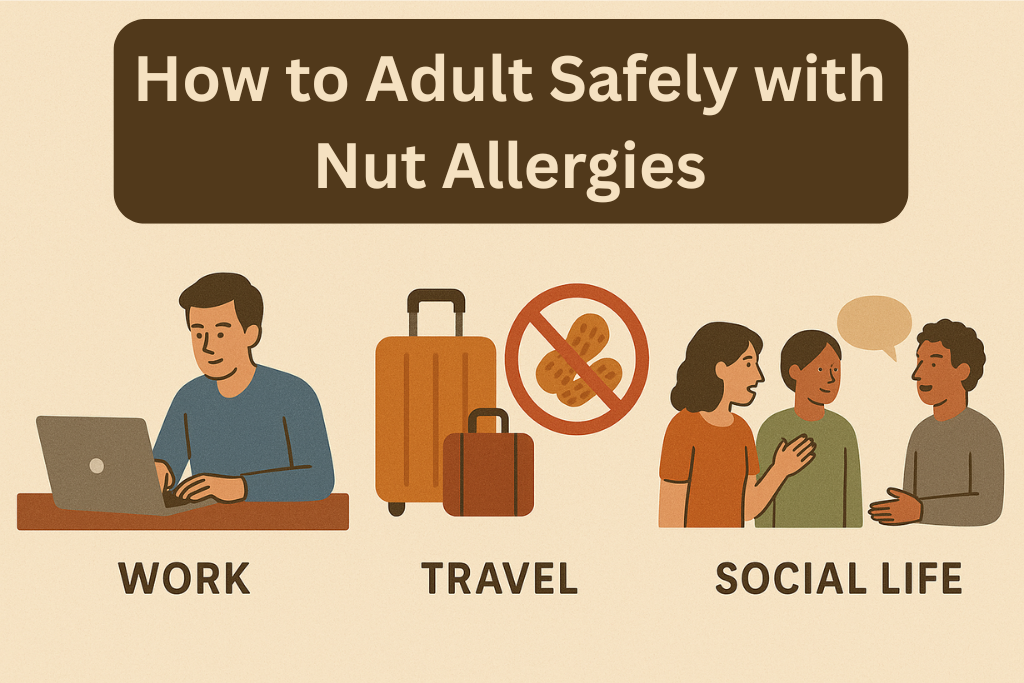
At work: how to make your allergy safe and invisible
Your allergy doesn’t have to define your working life — but if you ignore it, it can sabotage you. Here’s how to control your environment:
1. Educate your workplace
- Send a short email or handout to your team/manager: your allergy, what you need, how they can help (e.g., not bringing nut-house snacks into meeting space).
- Request that communal snacks in meetings label “may contain” or ideally avoid nuts.
2. Own your desk / snack zone
- Label your own food.
- Ask for a clean zone in the fridge/freezer for your pre-approved snacks.
- Keep a backup safe snack on you — you won’t always control lunch.
3. Business meals are your domain
- At lunch/dinner: call ahead, tell the restaurant explicitly “nut allergy, risk of cross-contact”.
- Bring your “safe dessert” or snack — don’t show up empty-handed.
- If hosting others, pick a restaurant known for allergy training and strong labelling.
Turning your allergy into systems, not stress, removes confusion and gives you control.
Travel (business or personal) with a nut allergies
Travel ups the risk. New airports, new hotels, unfamiliar food. Here’s a battle-tested travel checklist:
- Always carry two epinephrine auto-injectors (one on you, one in checked-or-carry-on bag).
- Print and keep a digital copy of your “Food Allergy & Anaphylaxis Emergency Plan” from your allergist.
- Email your airline/hotel ahead of time: request nut-free meal, ask about cleaning/cross-contact procedures.
- On the plane/train: wipe down tray tables/arm-rests, avoid shared pillows/blankets if unknown.
- At the hotel: check breakfast buffet, ask about kitchen allergens, keep a backup snack you trust.
- Research the destination: local food culture, hidden nut-uses (sauces, pastries), labelling laws if abroad.
- Know the nearest emergency department or hospital at destination.
When travel is systemized like a project, you reduce anxiety and you perform.
Relationships, social life & shared living
Food is social. Having an allergy changes how you show up — but it doesn’t have to shrink your life.
Dating / partnerships
- Disclose early (you’re not asking for pity — you’re setting expectations).
- If moving in together: set kitchen rules–certain zones nut-free, separate storage, clear cleaning protocol.
Social gatherings
- Before you attend: ask the host for safe-snack options + bring something you know is safe.
- Offer to help prepare or pick the restaurant — you don’t have to hide your allergy.
- Own your choices: you’re not ‘difficult’, you’re responsible — that’s strength.
Shared living and mixed kitchens are manageable when rules are clear, and you let others know how they can help (rather than piling the burden on yourself).
Mental health & the invisible burden
Having nut allergies as an adult comes with cumulative strain: constant alertness, the “will this meal kill me” question, the social exclusion when mates snack and you can’t. Studies show adults with food allergies report anxiety, fear of reactions, avoidance behaviors and lower quality of life.
Here’s how to handle the mental load:
- Reframe your allergy: it’s not a limitation — it’s a signal you’ve built a higher-standard system for your life.
- Build self-advocacy muscles: speaking up, asking questions, being your own best advocate grows confidence.
- Lean on community: find support groups of adults living with food allergy (FARE’s “Adults with Food Allergies” resource is a start).
- Practice self-care and down-time: your vigilance takes energy. Make space to recharge.
- Celebrate wins: you handled a corporate dinner safely. You travelled and came home fine. Recognise the wins — they reinforce the system working.
Action Plan: Your 10-Step Adult Nut Allergy Survival Kit
Here’s your checklist — bookmark it, print it, embed it into your lifestyle:
- Carry two epinephrine auto-injectors everywhere.
- Secure your personalized emergency action plan & store it digitally.
- At work: present a one-pager about your allergy and needed accommodations.
- Maintain labelled storage and a “safe snack zone” at your workplace.
- Before travel: vet airline, hotel & destination for allergen protocols.
- Dining out: call ahead, vet menu, bring safe dessert/snack, confirm cross contact protocols.
- Social/relationship: disclose early, set home kitchen rules if co-habiting.
- Home: designate nut-safe zones, label your food, communicate with housemates or partner.
- Mental health: schedule check-ins with yourself; join peer support; practice mindfulness or calming habits.
- Track your wins: journal what went right, what you handled well — this reinforces your mastery of your allergy system.
Conclusion
Living with nut allergies as an adult doesn’t mean shrinking your life. It means building systems, choosing high-standards, and navigating work, travel, relationships and social scenes with clarity and confidence. You’re in the driver’s seat. The allergy is a variable — you determine the solution.
Use this guide, adapt the checklist, ask the clear questions, advocate for yourself. Life with a nut allergy isn’t second-class — it’s just different. And with the right mindset and tools, it’s fully free.
Disclaimer: This article is for educational purposes only and does not constitute medical advice. Always consult a qualified allergist or healthcare professional for diagnosis, management and treatment of serious allergies.